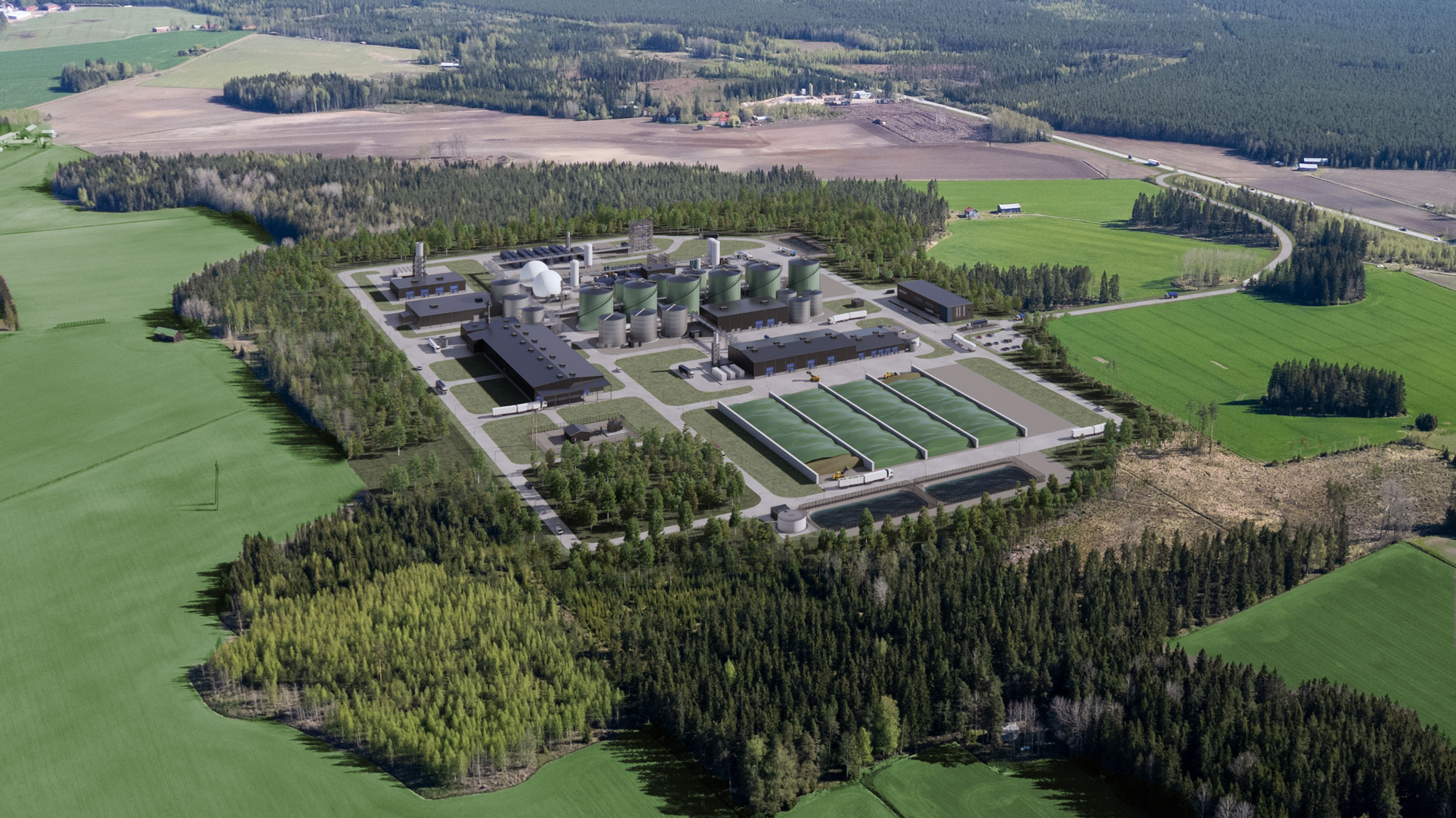



The design of the Southwest Finland Biorefinery has been refined further. A new, more compact layout reduces the site area needed by about 2.5 hectares and cuts construction costs by several million euros.
During the FEL 2 phase, the biorefinery planned for Oripää in southwest Finland has become considerably more cost- and energy-efficient. The biggest change is that the plant will no longer be built as one large building complex. Part of it will be made up of separate modules. This reduces the plant’s footprint, shortens the distances between processes and makes energy flows more efficient.
Project director Taavi Vartela of Wega says the team did more than fine-tune the earlier plan. They reassessed the whole concept and reviewed the plant layout from the ground up with a wide range of equipment suppliers. The partly modular design makes the plant more compact and leaves room for possible future expansion. “This is now Biorefinery 2.0,” Vartela says.
Site area reduced by 2.5 hectares
Under the new plan, about 2.5 hectares previously reserved for construction can be left undeveloped. This benefits the environment and saves costs. Together, the design changes are expected to reduce total construction costs by several million euros.
The plant will also have a wider buffer zone around it, which reduces its visibility in the surrounding landscape.
AFRY is the FEL 2 engineering partner for the Southwest Finland Biorefinery. The new solution was developed in close cooperation between AFRY’s experts and Wega’s own team. Wega CEO Niko Ristikankare says it took a great deal of engineering to make such a complex plant both more functional and much more cost-effective, and thanks AFRY’s designers and Wega’s project team.
A basis for the next phases
Biorefinery 2.0 will serve as the basis for further planning. The next phase is FEL 3, which will include FEED studies for the plant’s various process packages, taking the technical solutions towards implementation.
While the way the plant is built has changed, the core idea of the project remains the same. The biorefinery will turn side streams from agriculture and the food industry into renewable energy and recycled fertilisers, supporting agriculture and reducing nutrient loading in the Archipelago Sea.
The industrial-scale biorefinery will process about 625,000 tonnes of manure, field biomass and clean food industry side streams each year. It will produce liquefied biomethane (Bio-LNG) and e-methane (e-LNG) for heavy road transport, shipping and industry, as well as recycled fertilisers.
Contacts
Niko Ristikankare
CEO, Wega
+358 50 347 2528
Taavi Vartela
Project Director, Southwest Finland Biorefinery, Wega
+358 44 252 8006